Taurine is an amino acid that your body already produces itself, and at the doses found in cans, the EFSA concluded in 2009 that it poses no safety concern. It is not what gives you the boost from an energy drink: that's caffeine, and often sugar. So why is it found everywhere, and why does it have such a bad reputation? Let's sort out the myth, the figures, and what you really need to watch for on the label.
Updated September 30, 2026
What exactly is taurine?
Taurine is a sulfur-containing amino acid that the human body naturally produces, mainly in the liver, and that is found in significant amounts in the heart, muscles, retina, and brain. Unlike standard amino acids, it is not used to build proteins. It is involved in particular in the formation of bile salts, which help digest fats, and in maintaining the balance of water and minerals inside cells.
Your diet also provides some. Meat, fish, and especially seafood contain it, whereas plants contain virtually none. In a healthy adult who eats a varied diet, the body combines its own production with these dietary sources without you having to think about it.
No, it doesn't come from bulls
Taurine was first isolated in 1827 from ox bile, which is why its name comes from the Latin taurus. That's the only thing linking it to bulls. The taurine in energy drinks is produced through chemical synthesis, with no ingredients of animal origin. The myth persists, but it is false.
Why do brands add taurine to their cans?
Brands add taurine to their cans mainly because of marketing legacy: the recipe for the first energy drinks in the 1980s and 1990s combined it with caffeine and sugar, and almost the entire market copied the formula. The word sounds technical, reassures consumers that the drink does something, and has become a marker of the category.
Scientifically, the picture is much less spectacular. No health claim about taurine currently appears in the European register of authorized claims. In other words, a brand is not allowed to write on its can that taurine improves your concentration, energy, or performance, because these effects have not been sufficiently demonstrated in the eyes of the European authorities.
Taurine and danger: what the EFSA says
No, taurine alone is not considered dangerous at the doses used in energy drinks: the European Food Safety Authority (EFSA) concluded in 2009 that exposure to taurine at these levels poses no safety concern, including among heavy regular consumers. In the animal studies reviewed by EFSA, no adverse effects were observed up to 1,000 mg per kilogram of body weight per day, a dose far above what a can provides.
So where does the bad reputation come from? Concerns about energy drinks (palpitations, nervousness, disrupted sleep) relate to the complete cocktail and the way it is consumed: lots of caffeine, lots of sugar, sometimes mixed with alcohol, and often several cans in a row. Taurine was blamed by association because it is the ingredient with the most mysterious name on the list.
The real point to watch is caffeine
The EFSA sets 400 mg per day as the amount of caffeine considered safe for a healthy adult, and 200 mg in a single intake. This is the figure to keep in mind when you have coffee, tea, and cans of energy drink throughout the same day. In Europe, any drink containing more than 150 mg of caffeine per liter must also display the statement “High caffeine content” on its label, in addition to the exact amount.
How much taurine is in a can of energy drink?
A standard 250 ml can of energy drink generally contains around 1,000 mg of taurine, or approximately 4,000 mg per liter, so a large 500 ml can contains twice as much. These are the values most commonly found on the labels of conventional energy drinks sold in Belgium and France.
| Drink | Size | Taurine | Caffeine |
|---|---|---|---|
| Classic energy drink | 250 ml | approximately 1,000 mg | approximately 80 mg |
| Large-format energy drink | 500 ml | approximately 2,000 mg | approximately 160 mg |
| Buddy can | 250 ml | 0 mg | 80 mg, from guarana |
| Cup of filter coffee | 200 ml | 0 mg | approximately 90 mg (EFSA reference) |
These figures are estimates, and each recipe has its own values. The simplest option is still to check the brand you drink: an independent comparison tool such as drinkscore, which lists the composition of energy drinks brand by brand, lets you check caffeine, sugar, and additives without taking our word for it.
Taurine or caffeine: which one really gives you energy?
It is caffeine, not taurine, that produces the stimulating effect of an energy drink, and it is the only one of the two whose effect on alertness EFSA has favorably assessed, from 75 mg per serving. Sugar adds a rapid energy spike, often followed by a crash. Taurine, on the other hand, has no proven energizing effect.
The source of the caffeine also affects how you feel its effects. In the guarana seed, caffeine is bound to tannins, and many consumers describe a more gradual effect than with synthetic caffeine added as a powder, although studies on this point remain limited. If you want to explore this further, we explain it in detail in our article on the difference between natural and synthetic caffeine.
How to read an energy drink label in 30 seconds
To assess an energy drink, look first at the amount of caffeine per can, then the amount of sugar per 100 ml, and finally the list of additives. Taurine is not the decisive criterion.
Caffeine per can
Always relate the content to the actual serving size. A drink labeled as containing 32 mg per 100 ml provides 80 mg in 250 ml, but 160 mg in 500 ml, already close to half the EFSA daily reference value in a single can.
Sugar per 100 ml
Many classic energy drinks contain around 11 g of sugar per 100 ml, or more than 27 g per 250 ml can. Sugar-free versions replace this sugar with sweeteners such as sucralose or acesulfame K, which lowers the calorie count but does not change the caffeine dose.
Additives
Colorants, preservatives, flavorings, vitamins added in bulk: the longer the list, the further the drink gets from a simple recipe. To see what a shorter alternative looks like, our guide to natural energy drinks reviews the ingredients that appear most often.
Why Buddy contains no taurine
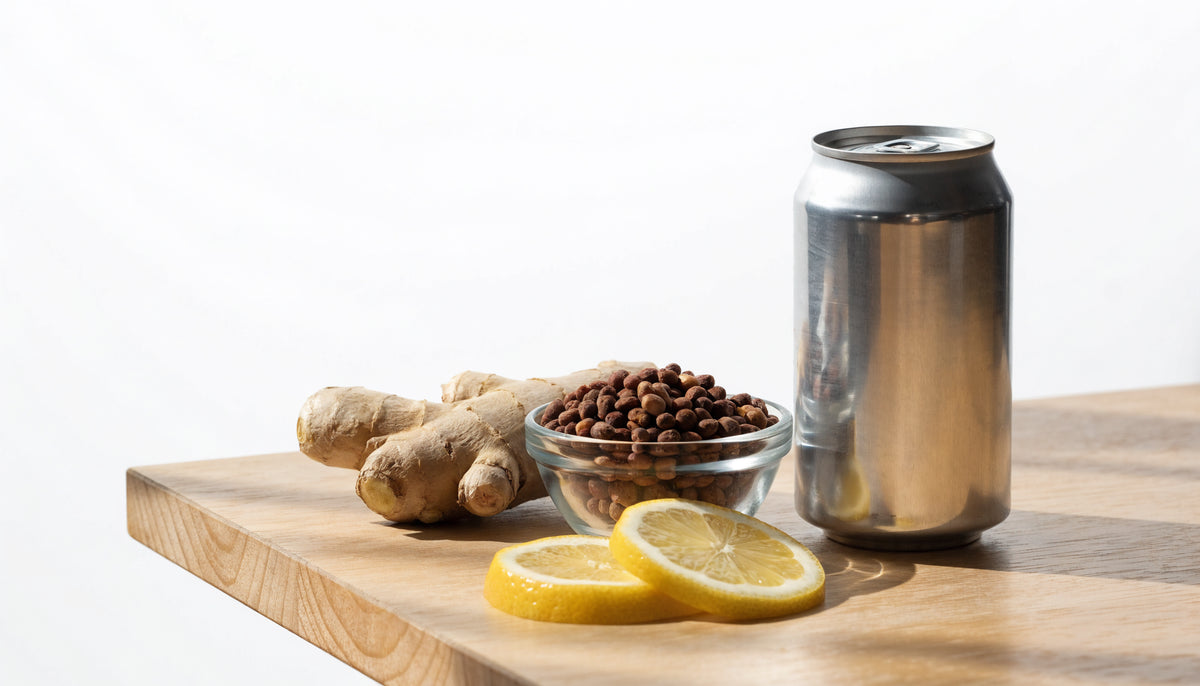
Buddy cans contain no taurine: their 80 mg of caffeine come exclusively from guarana, with 13 kcal per 100 ml, in an organic recipe with Ginkgo biloba. We made this choice simply because taurine has no proven effect on your energy, and we prefer a short ingredient list where every line has a reason to be there.
No sweetener, no coloring, and no preservatives either. You can compare the ingredients yourself on the product page for the Buddy natural energy drink, available in Lemon Ginger, Mango Passion, Pomegranate Hibiscus, and Yerba Mate. And if you want to try all four, the Discovery Pack is available in the Buddy store from €20.99.
One final piece of advice that applies to all cans, including ours: caffeine remains active for several hours. To know when to stop during the day, take a look at our article on caffeine and sleep.
Frequently asked questions about taurine
Is taurine of animal origin?
No, the taurine added to energy drinks is produced through chemical synthesis, with no animal ingredient. Its name simply comes from the fact that it was discovered in 1827 in ox bile.
How much taurine does a 250 ml can contain?
A standard 250 ml can generally contains around 1,000 mg of taurine. Buddy cans contain none at all.
Does taurine give you energy?
No energizing effect of taurine is recognized by European authorities. The stimulating effect of an energy drink comes from caffeine and, in sweetened versions, sugar.
How many energy drinks per day are safe?
It all depends on your total caffeine intake for the day: EFSA considers up to 400 mg per day safe for a healthy adult, including coffee and tea, and up to 200 mg in a single intake.
Why does taurine have such a bad reputation?
Taurine is often wrongly blamed for the effects of the full blend in an energy drink, which is high in caffeine and sugar. EFSA concluded in 2009 that taurine, at the doses used in these drinks, poses no safety concern.
In summary
Taurine is neither a poison nor a miracle ingredient: it is an amino acid your body already knows, considered safe by EFSA at the doses found in cans, but with no demonstrated energizing effect. When you choose an energy drink, look first at the caffeine per can, then at the sugar and the length of the ingredient list. That is where the real difference lies.