What to drink during exam season: a guide to getting through your study days
During exam season, water is still the best drink, with a little well-timed caffeine in the morning and nothing more at the end of the day. Simple on paper, much less so at 11 p.m. in front of a 300-page syllabus.
December exam season is just around the corner, and with it come back-to-back coffees, cans next to the keyboard, and nights that are too short. So we’ve gathered what really matters: how much to drink, how much caffeine, when to stop, and how to fit it all into a real day of studying.
No miracle recipe here, just figures and sources to help you make an informed decision too.
What to drink during exam season: the short answer
During exam season, drink water throughout the day, save caffeine for the morning and early afternoon, and avoid very sugary drinks that make your energy spike and then crash.
Later remains the foundation, and it’s enough in the vast majority of situations. Caffeine, on the other hand, is a tool: useful when you get the dose and timing right, counterproductive when it’s used to make up for four-hour nights.
This guide is part of our series on concentration. If you want to learn more about what’s happening on your plate and in your glass, our guide to natural nootropics for concentration covers the ingredients people talk about most.
How much water to drink per day while studying
For adults, the European Food Safety Authority (EFSA) sets total water intake at 2 liters a day for women and 2.5 liters for men, around one fifth of which already comes from food.
In practical terms, that’s around 1.5 to 2 liters over the course of the day. Studying while sitting doesn’t make you sweat, but December heating and hour after hour without getting up can easily make you forget to drink.
Tips that really work
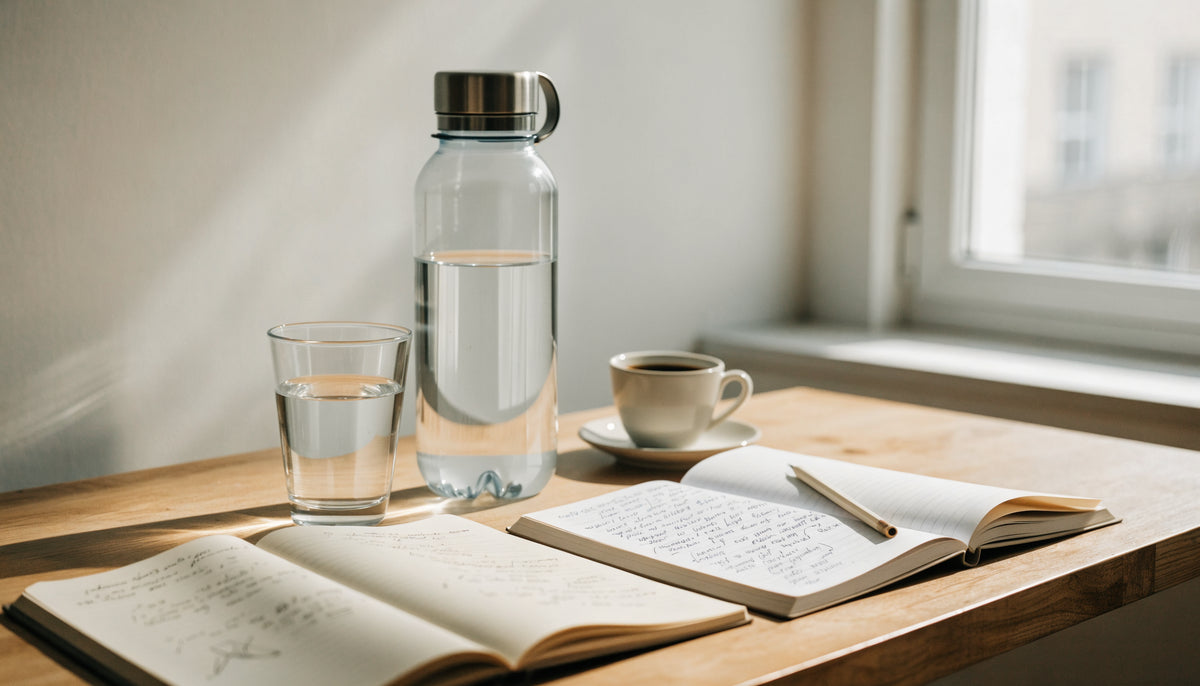
- Keep a filled bottle or water flask on your desk and finish it before each break.
- A glass of water when you wake up, before your first coffee.
- Have a glass at the end of each study block: that way, your break is also a chance to drink.
- Check the color of your urine: if it’s light, you’re fine; if it’s dark, it’s time to drink.
We cover other habits of the same kind in our article on staying hydrated at work, which applies just as well to a day in a student flat or library.
Caffeine during exam season: how much per day
For a healthy adult, the EFSA considers an intake of up to 400 mg of caffeine per day from all sources to be safe, and a single dose of up to 200 mg to be risk-free.
400 mg sounds like a lot, but it adds up quickly: three drip coffees and a can in the early afternoon, and you’re there. The most useful thing isn’t to aim for the maximum, but to know how much you’re actually consuming.
Caffeine guide by drink
The averages below come from EFSA guidelines for common drinks and BUDDY labels for our two energy products.
| Drink | Serving | Caffeine |
|---|---|---|
| Drip coffee | 200 ml | about 90 mg |
| Espresso | 60 ml | about 80 mg |
| Black tea | 220 ml | about 50 mg |
| Cola | 355 ml | about 40 mg |
| BUDDY can | 250 ml | 80 mg (guarana) |
| BUDDY Energy Stick | 1 stick | 82 mg (natural caffeine) |
Caffeine content varies a lot from brand to brand, especially for energy drinks. To check what’s really in your can, drinkscore.info is an independent comparison site that lists the caffeine and sugar content of each brand based on its labels.
When to stop consuming caffeine to sleep well
To protect your sleep during exam season, stop consuming caffeine by early afternoon at the latest, around six hours before bedtime.
L’EFSA notes that a dose of around 100 mg taken shortly before bedtime can increase the time it takes some adults to fall asleep. It’s at night that you consolidate what you studied during the day, so sacrificing sleep for one extra hour of revision is rarely a good trade-off.
We devoted an entire article to the topic, with a calculation based on your bedtime: caffeine and sleep: when to stop.
A typical study day: what to drink and when
The easiest way to stay hydrated during exam season is to schedule your drinks around your study blocks instead of drinking at random.
| When | What to drink | Why |
|---|---|---|
| Wake-up | A large glass of water | You haven't had anything to drink for eight hours |
| Breakfast | A coffee or tea | First caffeine of the day, with a proper meal |
| Morning | Water as needed | Finish a water bottle before noon |
| Lunch | Water | Avoid sugary sodas that make digestion heavier |
| Early afternoon | If needed, a coffee, a can or an energy stick | Last caffeine of the day |
| Late afternoon | Water, caffeine-free herbal tea | Get a good night's sleep |
| Evening | Water | No caffeine after about 4 p.m. if you're going to bed around 11 p.m. |
Adjust the timings to your routine: if you go to bed at 1 a.m., your cutoff time moves back accordingly. LThe idea is the same: caffeine in the morning, water all day.
Energy drink during exam revision: good or bad idea
An energy drink during exam revision can have its place if it replaces a coffee, not if it's added to four other sources of caffeine throughout the day.
What makes the difference is the amount of caffeine, the amount of sugar and the timing. A regular 500 ml can may contain over 50 g of sugar and 160 mg of caffeine, equivalent to two servings at once. By contrast, a 250 ml BUDDY organic can provides 80 mg of caffeine from guarana and 2.7 g of sugar per 100 ml, equivalent to one coffee.
It comes in four flavours: Lemon Ginger, Pomegranate Hibiscus, Mango Passion Fruit and Mint Elderflower. It also contains ginkgo extract, but to be clear: it's no shortcut to passing your exams, just a lighter alternative to coffee after lunch.
The stick format for the library
If you're studying at the library or in a study room, the BUDDY powdered energy stick fits in a pencil case and mixes into your water bottle. It provides 82 mg of natural caffeine, about the same as one espresso, with no sugar and just 8 kcal. Grapefruit Jasmine and Raspberry flavours.
For a broader comparison of the options, our top 7 drinks to stay focused reviews coffee, tea, matcha and more.
Mistakes to avoid during exam revision
The three most common mistakes during exam prep are forgetting to drink water, combining caffeine sources without keeping track, and continuing to have caffeine in the evening.
- Counting your morning coffee, break-time tea, lunchtime cola, and 5 p.m. can separately, when they all add up.
- Using caffeine to make up for a sleepless night: it masks fatigue; it doesn’t replace sleep.
- Replacing water with sodas or juice: you’re adding a lot of sugar without hydrating any better.
- Drinking an energy drink right before the exam without having tried it beforehand: on the day, stick to your usual routine.
What to drink on exam day
On exam day, stick to exactly the same drinks as during exam prep and bring a bottle of water into the room if the rules allow it.
If you have coffee every morning, stick to your usual coffee. If you never drink it, this isn’t the day to start. For an afternoon exam, aim to have your last caffeine at lunchtime, not just before you go in.
In summary
Drink water throughout the day, have caffeine in the morning and until early afternoon, then none after that, and keep your total below 400 mg. That’s all your exam prep routine needs when it comes to drinks. The rest comes down to your schedule, breaks, and sleep. Good luck with your exams!
Frequently asked questions about drinks during exam prep
How many coffees a day during exam prep?
For a healthy adult, the EFSA sets the limit at 400 mg of caffeine per day, or about four cups of filter coffee. It’s best to stay below that and count all sources, including tea, cola, and energy drinks.
What time should you stop drinking caffeine during exams?
Stop drinking caffeine about six hours before bedtime. If you plan to go to bed around 11 p.m., have your last cup or can by 4 p.m. at the latest.
An energy drink during exam prep: good idea or not?
It’s a good idea if it replaces a coffee and you keep caffeine and sugar moderate; it’s a bad idea if you add it on top of other sources. Check the caffeine and sugar content on the label before choosing.
How much water should you drink when studying all day?
Aim for 1.5 to 2 liters of drinks a day, prioritizing water. L'EFSA recommends a total intake of 2 liters for women and 2.5 liters for men, including food.
What should you drink on the morning of an exam?
Drink water and stick to your usual morning drink, coffee or tea. Avoid trying a new caffeinated drink on the day itself.